
Residential vs Commercial Real Estate Which Investment Strategy Delivers Better Returns
CategoriesReal Estate

Residential vs Commercial Real Estate: Which Investment Strategy Delivers Better Returns?

Real estate remains one of the most resilient and versatile asset classes for long-term wealth creation. However, investors often face a fundamental strategic decision: whether to allocate capital to residential real estate, commercial real estate, or a combination of both. Each asset class offers distinct advantages, risk profiles, and return dynamics, making it essential to understand their performance characteristics before structuring an investment portfolio.

At ODAS Star Real Estate, we support investors in developing tailored real estate strategies that balance income stability, capital appreciation, and long-term asset resilience. The choice between residential and commercial real estate is not a binary decision, but rather a strategic allocation challenge that depends on financial objectives, market conditions, and risk tolerance.

1. Understanding Residential Real Estate Investments

Residential real estate includes properties such as apartments, villas, townhouses, and multi-family housing units. These assets are primarily income-generating through rental income and offer long-term capital appreciation driven by population growth, urbanization, and housing demand.

One of the key advantages of residential real estate is its broad tenant base. Demand for housing is structurally stable, making residential properties less vulnerable to economic downturns compared to other asset classes. Even during periods of market volatility, people require accommodation, which supports consistent rental demand and relatively low vacancy rates.

From a liquidity perspective, residential assets are easier to buy and sell than commercial properties. The wider pool of potential buyers and standardized property formats enhance market accessibility and transaction speed. This liquidity advantage is particularly valuable for investors who prioritize portfolio flexibility and exit optionality.

Residential properties also offer lower entry barriers, making them accessible to a broader range of investors. Financing options are typically more favorable, with lower minimum investment thresholds and more flexible mortgage structures.

However, residential real estate also presents operational challenges. Tenant turnover rates are generally higher, requiring more frequent leasing activity and property management interventions. Maintenance costs, tenant disputes, and regulatory compliance obligations can increase operational complexity for investors without professional asset management support.

At ODAS Star Real Estate, residential investment opportunities are structured to minimize these challenges through professional property management services, tenant screening processes, and long-term leasing strategies.

2. Understanding Commercial Real Estate Investments

Commercial real estate encompasses office buildings, retail centers, industrial properties, logistics hubs, and mixed-use developments. These assets are typically leased to businesses and generate income through long-term commercial leases.

One of the primary advantages of commercial real estate is its higher yield potential. Commercial properties often deliver stronger net operating income (NOI) compared to residential assets, particularly in high-demand business districts and logistics corridors.

Long-term lease agreements provide income stability and predictable cash flow. Commercial tenants frequently sign multi-year leases with built-in rental escalations, reducing vacancy risk and enhancing revenue visibility.

Commercial real estate also benefits from lower tenant management intensity. Business tenants are typically responsible for property maintenance, utilities, and operational expenses under triple-net lease structures. This reduces the operational burden for property owners and improves net income margins.

However, commercial real estate investments require higher capital commitments and more complex due diligence processes. Market entry costs, regulatory compliance requirements, and tenant credit risk assessments increase transaction complexity.

In addition, commercial real estate is more sensitive to economic cycles. Business contraction, remote work trends, and retail market disruptions can impact tenant demand and rental pricing. Investors must carefully assess market conditions, sector-specific risks, and long-term demand trends before allocating capital to commercial assets.

ODAS Star Real Estate mitigates these risks through disciplined tenant selection, location strategy, and diversified commercial portfolio construction.

3. Return Profiles and Risk Comparison

The return dynamics of residential and commercial real estate differ significantly in terms of income stability, capital appreciation, and risk exposure.

Residential real estate typically offers moderate rental yields combined with long-term capital appreciation. Its performance is closely linked to demographic trends, housing supply dynamics, and urban development policies. This asset class is well-suited for investors seeking stable income and long-term asset preservation.

Commercial real estate, on the other hand, often delivers higher rental yields and stronger short-term cash flow. However, its performance is more sensitive to macroeconomic conditions, business cycles, and sector-specific demand fluctuations.

From a risk perspective, residential assets offer greater resilience due to consistent housing demand and diversified tenant bases. Commercial assets carry higher tenant concentration risk, as the loss of a single large tenant can significantly impact cash flow.

Liquidity also varies between the two asset classes. Residential properties generally offer faster exit options, while commercial assets may require longer marketing periods and more complex transaction processes.

4. Strategic Portfolio Allocation

Rather than choosing between residential and commercial real estate, sophisticated investors often adopt a blended portfolio strategy. By combining both asset classes, investors can achieve diversification benefits, risk mitigation, and optimized return performance.

A balanced real estate portfolio may include:

• Residential rental properties for income stability
• Commercial assets for higher yield potential
• Mixed-use developments for diversified revenue streams
• International properties for geographic diversification

This multi-asset allocation approach enhances portfolio resilience and reduces exposure to localized market risks.

At ODAS Star Real Estate, we design customized portfolio strategies that align with each investor’s financial objectives, risk tolerance, and long-term vision. Our advisory services support clients in structuring diversified real estate portfolios that deliver consistent financial performance across market cycles.

5. Choosing the Right Strategy for Your Investment Goals

The optimal real estate investment strategy depends on several critical factors, including investment horizon, income requirements, capital availability, and risk appetite.

Investors seeking stable income and long-term asset preservation may prioritize residential real estate. Those targeting higher yields and accelerated cash flow may favor commercial properties. Institutional investors and high-net-worth individuals often adopt blended strategies to capture the benefits of both asset classes.

Professional advisory support is essential in navigating these strategic decisions. Comprehensive market analysis, financial modeling, and risk assessment enable investors to make informed portfolio allocation choices.

ODAS Star Real Estate provides end-to-end advisory services designed to guide investors through asset selection, portfolio structuring, and long-term asset management.

Conclusion

Residential and commercial real estate each offer distinct advantages and performance characteristics. Residential assets provide income stability, liquidity, and long-term capital appreciation, while commercial properties deliver higher yield potential and long-term lease security.

Rather than viewing these asset classes as competing options, investors should consider them as complementary components of a diversified real estate portfolio. By aligning investment strategy with financial objectives and market conditions, investors can optimize portfolio performance and achieve sustainable long-term returns.

At ODAS Star Real Estate, we support investors in building strategic real estate portfolios that balance income stability, growth potential, and risk resilience, delivering long-term value across residential and commercial markets.


CategoriesNews

How to Build a High-Performance Real Estate Investment Portfolio

Building a high-performance real estate investment portfolio requires more than acquiring properties in attractive locations. It demands a disciplined strategy, comprehensive market intelligence, risk management, and long-term financial planning. For private investors, family offices, and institutional clients alike, real estate remains one of the most reliable asset classes for wealth creation and capital preservation when approached with a structured investment framework.


At ODAS Star Real Estate, portfolio development is guided by data-driven analysis, regulatory due diligence, and a long-term value creation philosophy. Our objective is to help investors build diversified, resilient, and income-generating property portfolios that perform consistently across market cycles.


1. Define Clear Investment Objectives

The foundation of any high-performance real estate portfolio is a clear understanding of investment objectives. Investors must determine whether their primary focus is income generation, capital appreciation, or a balanced combination of both.

Income-focused portfolios prioritize assets that generate stable rental yields, such as residential rental properties, serviced apartments, and well-located commercial units. Growth-oriented portfolios, on the other hand, emphasize properties in emerging markets or redevelopment zones with strong capital appreciation potential.


Establishing a defined risk tolerance, investment horizon, and liquidity requirement allows investors to structure a portfolio that aligns with their long-term financial goals. ODAS Star Real Estate supports clients through strategic planning consultations to ensure that portfolio objectives are clearly defined and operationally achievable.


2. Diversify Across Property Types and Markets

Diversification is a critical principle in building a resilient real estate investment portfolio. By spreading capital across multiple property types and geographic regions, investors reduce exposure to market volatility and localized economic risks.


A well-balanced portfolio typically includes a mix of residential, commercial, and mixed-use properties. Residential assets provide stable income and strong tenant demand, while commercial properties offer higher yield potential and long-term lease structures. Mixed-use developments add further diversification by combining multiple revenue streams within a single asset.


Geographic diversification is equally important. Investing across different cities, countries, or economic regions helps mitigate political, regulatory, and currency risks. ODAS Star Real Estate offers access to both domestic and international property markets, enabling clients to build globally diversified portfolios that enhance long-term stability.


3. Focus on High-Demand Locations

Location remains a fundamental driver of real estate performance. Properties situated in high-growth urban areas, transportation hubs, and emerging business districts consistently demonstrate stronger rental demand, lower vacancy rates, and higher resale value.


Investors should prioritize markets with robust infrastructure development, population growth, and economic diversification. Factors such as public transport connectivity, proximity to employment centers, and access to essential services play a significant role in tenant attraction and long-term asset value.


ODAS Star Real Estate applies rigorous location analysis to every investment opportunity, evaluating economic indicators, zoning regulations, demographic trends, and long-term development plans to ensure that assets are positioned for sustained growth.


4. Apply Disciplined Financial Analysis

High-performance real estate portfolios are built on disciplined financial modeling and performance forecasting. Investors must assess each asset’s projected cash flow, operating expenses, financing costs, and long-term appreciation potential.


Key financial metrics such as net operating income (NOI), capitalization rates, internal rate of return (IRR), and debt service coverage ratios (DSCR) provide critical insights into asset performance. Sensitivity analysis and scenario modeling help evaluate how properties may perform under different economic conditions, including interest rate fluctuations and rental market shifts.


At ODAS Star Real Estate, every investment opportunity is supported by detailed financial projections and risk assessments, ensuring that clients make informed decisions based on objective performance data rather than speculative assumptions.


5. Incorporate Professional Asset Management

Effective asset management is essential for maintaining portfolio performance over time. Beyond acquisition, investors must focus on tenant retention, lease optimization, maintenance efficiency, and operational cost control.


Professional property management services enhance asset value by ensuring that properties remain well-maintained, financially optimized, and compliant with regulatory standards. Proactive asset management also enables timely adjustments to rental pricing, lease structures, and capital improvement strategies.


ODAS Star Real Estate provides integrated asset management solutions, including tenant sourcing, lease administration, maintenance coordination, and financial reporting. These services are designed to maximize rental income, minimize vacancy risk, and protect long-term asset value.


6. Manage Risk Through Strategic Planning

Risk management is a central component of any high-performance real estate portfolio. Investors must anticipate and mitigate risks related to market volatility, regulatory changes, financing conditions, and tenant stability.


Strategic planning involves maintaining adequate liquidity reserves, diversifying financing structures, and implementing contingency strategies for adverse market scenarios. Insurance coverage, legal compliance audits, and regulatory due diligence further reduce exposure to operational and legal risks.


ODAS Star Real Estate supports investors through comprehensive risk management frameworks that prioritize asset resilience, regulatory compliance, and financial sustainability.


7. Adopt a Long-Term Investment Mindset

Successful real estate investors understand that sustainable wealth creation is achieved through long-term strategic planning rather than short-term speculation. Market fluctuations, interest rate cycles, and economic shifts are inherent components of real estate investment, but disciplined portfolio management enables investors to navigate these challenges effectively.


A long-term investment mindset emphasizes stable income generation, incremental value appreciation, and continuous portfolio optimization. By reinvesting cash flow, upgrading properties, and selectively acquiring new assets, investors can compound portfolio growth over time.


ODAS Star Real Estate aligns its investment strategy with this long-term vision, delivering property opportunities designed to perform consistently across multiple market cycles.


Conclusion

Building a high-performance real estate investment portfolio requires a structured strategy, disciplined financial analysis, and long-term planning. By defining clear investment objectives, diversifying across property types and markets, focusing on high-demand locations, and implementing professional asset management, investors can create resilient portfolios that deliver sustainable financial performance.


At ODAS Star Real Estate, we combine market intelligence, strategic advisory, and operational excellence to support investors in building real estate portfolios that generate long-term value, income stability, and financial security.

CategoriesNews

ODAS STAR REAL ESTATE – Strategic Real Estate Solutions for a Global Market

ODAS Star Real Estate is a professional real estate advisory and development firm focused on delivering high-value property solutions for private investors, corporate clients, and international partners. Operating at the intersection of strategic investment planning and premium real estate development, the company provides a comprehensive portfolio of services designed to support long-term asset growth, financial stability, and sustainable value creation.

With a disciplined, data-driven approach, ODAS Star Real Estate positions itself as a trusted partner for clients seeking reliable, transparent, and performance-oriented real estate opportunities. From luxury residential developments to income-generating commercial properties and international investment portfolios, the company’s activities are structured around clear financial objectives, regulatory compliance, and long-term market relevance.

A Comprehensive Real Estate Services Platform

ODAS Star Real Estate offers an integrated real estate services platform covering the full lifecycle of property investments. Its core activities include property acquisition, development, investment advisory, leasing, and asset management. Each project is supported by in-depth market research, financial modeling, and regulatory due diligence to ensure optimal risk management and return potential.

The company’s real estate advisory services are designed to help clients identify, evaluate, and structure real estate investments that align with their financial goals. Whether supporting first-time investors or managing large-scale institutional portfolios, ODAS Star Real Estate provides tailored strategies that balance growth potential with income stability.

By combining local market expertise with international investment standards, the firm ensures that each transaction and development adheres to the highest levels of professional governance and transparency.

Luxury Residential Developments

A core pillar of ODAS Star Real Estate’s operations is the development of premium residential properties. These projects are designed to meet the evolving expectations of modern homeowners while also serving as high-performance investment assets.

Each residential development is carefully planned from concept to completion, with a strong emphasis on architectural excellence, functional design, and long-term durability. The company collaborates with leading architects, engineers, and interior designers to create living environments that combine lifestyle sophistication with practical value.

Location strategy plays a central role in residential development. ODAS Star Real Estate prioritizes high-growth urban areas, emerging investment zones, and premium waterfront districts that demonstrate strong demand, infrastructure quality, and long-term capital appreciation potential. This strategic site selection enhances both end-user appeal and investor performance metrics.

Sustainability and smart infrastructure are integrated into every residential project. Energy-efficient systems, sustainable materials, and modern building technologies are used to improve environmental performance and reduce long-term operating costs, increasing asset value over time.

Commercial Real Estate and Income-Generating Assets

In addition to residential developments, ODAS Star Real Estate is actively engaged in commercial real estate projects that support business growth and long-term income generation. The firm’s commercial portfolio includes office buildings, retail centers, mixed-use developments, and logistics-oriented properties.

Commercial developments are positioned in high-visibility locations with strong transport connectivity and access to skilled labor markets. Each project is designed to meet the operational needs of modern enterprises, offering flexible layouts, advanced building systems, and scalable infrastructure.

From an investment perspective, commercial real estate assets are structured to deliver consistent cash flow and long-term value appreciation. ODAS Star Real Estate applies disciplined leasing strategies, competitive rental pricing models, and proactive asset management practices to maintain financial performance across market cycles.

Tenant satisfaction and retention are key priorities. By working closely with corporate tenants and service providers, the firm ensures that commercial properties remain aligned with evolving business requirements and market trends.

Smart Investment Properties and Advisory Services

ODAS Star Real Estate offers a curated portfolio of smart investment properties designed to provide stable returns and capital growth. These assets undergo a comprehensive due diligence process, including financial modeling, location analysis, regulatory review, and market trend assessment.

The company’s investment advisory services support clients in structuring diversified real estate portfolios that balance high-growth assets with stable income-producing properties. This strategic diversification approach enhances portfolio resilience and long-term financial performance.

Investors receive detailed investment briefs, performance projections, and risk assessments for each opportunity. This transparency enables informed decision-making and reinforces the company’s commitment to ethical, client-centered operations.

International Property Portfolio

ODAS Star Real Estate operates across key domestic and international markets, offering clients access to high-value real estate opportunities worldwide. The firm’s international strategy focuses on economically stable regions with transparent legal frameworks and strong long-term growth indicators.

Through a network of international legal advisors, financial institutions, and local real estate professionals, ODAS Star Real Estate manages cross-border transactions, regulatory coordination, and currency risk mitigation. This integrated approach minimizes investment risk and ensures compliance with jurisdiction-specific requirements.

The international property portfolio includes residential developments, commercial properties, hospitality assets, and mixed-use projects. These assets are selected for their long-term growth potential, income stability, and strategic market positioning.

Governance, Transparency, and Long-Term Vision

ODAS Star Real Estate operates under a governance framework that prioritizes transparency, accountability, and regulatory compliance. Every transaction and development is supported by documented due diligence processes, financial reporting standards, and risk management protocols.

The company’s long-term vision is to build a globally recognized real estate platform that connects investors with high-quality property opportunities through a structured, ethical, and performance-driven framework.

By combining strategic planning, operational excellence, and market intelligence, ODAS Star Real Estate continues to deliver real estate solutions that generate sustainable value for clients and partners.

CategoriesNews

Emerging Real Estate Investment Trends Shaping the Global Property Market

The global real estate market is undergoing a period of strategic transformation driven by economic shifts, technological innovation, sustainability priorities, and changing investor behavior. For both private and institutional investors, understanding emerging real estate investment trends has become essential for capital preservation, portfolio growth, and long-term financial performance. At ODAS Star Real Estate, market intelligence and disciplined investment strategy form the foundation of every property opportunity we deliver.

1. The Rise of Data-Driven Real Estate Investment

One of the most significant trends shaping the modern real estate landscape is the increased reliance on data-driven decision-making. Investors are no longer relying solely on location, intuition, or historical price patterns. Instead, advanced analytics, predictive modeling, and real-time market data are being used to assess asset performance, rental demand, and long-term growth potential.

Sophisticated investors now expect detailed financial projections, risk assessments, and scenario modeling before committing capital. This shift has elevated transparency and accountability as core pillars of professional real estate investment. At ODAS Star Real Estate, every property opportunity undergoes comprehensive market research, financial modeling, and regulatory due diligence to ensure that investment decisions are based on objective performance metrics rather than speculation.

2. Strong Demand for Income-Generating Assets

As global interest rates fluctuate and inflationary pressures impact traditional financial instruments, income-generating real estate assets have become increasingly attractive. Properties that offer stable rental yields and predictable cash flow are now considered essential components of a balanced investment portfolio.

Residential rental properties, serviced apartments, mixed-use developments, and well-located commercial assets are particularly favored for their ability to generate recurring income while preserving capital value. Investors are prioritizing assets with low vacancy risk, strong tenant demand, and flexible leasing structures that can adapt to changing market conditions.

This trend reflects a broader shift toward long-term income stability rather than short-term speculative gains. ODAS Star Real Estate structures investment opportunities to meet these objectives by focusing on high-demand locations, resilient property types, and professionally managed assets.

3. Sustainability and ESG-Driven Investment Strategy

Environmental, Social, and Governance (ESG) factors are playing an increasingly influential role in real estate investment strategy. Investors, regulators, and financial institutions are now placing greater emphasis on sustainable development practices, energy efficiency, and long-term environmental impact.

Green buildings, smart infrastructure, and energy-efficient developments are no longer optional upgrades—they are becoming essential value drivers. Properties that incorporate sustainable materials, renewable energy systems, and modern building technologies tend to command higher rental premiums, lower operating costs, and stronger long-term asset valuations.

At ODAS Star Real Estate, sustainability is integrated into project planning, design, and asset management. Our developments prioritize energy efficiency, environmental compliance, and responsible land use, ensuring that assets remain competitive in a market increasingly shaped by ESG standards.

4. Growth of International and Cross-Border Investments

Globalization continues to reshape real estate investment patterns. High-net-worth individuals, institutional investors, and family offices are increasingly diversifying their portfolios through international property investments.

Markets such as the Middle East, Southeast Asia, and select European regions are attracting significant capital inflows due to favorable regulatory environments, strong economic growth, and long-term infrastructure development. Dubai, in particular, has emerged as a global real estate hub, offering political stability, investor-friendly policies, and world-class property developments.

Cross-border real estate investment requires specialized expertise in legal compliance, taxation, currency risk management, and regulatory frameworks. ODAS Star Real Estate supports international investors through a fully integrated advisory platform, ensuring seamless transaction execution and long-term asset protection.

5. The Expansion of Mixed-Use Developments

Mixed-use developments are becoming a dominant trend in modern real estate planning. These projects integrate residential, commercial, retail, and leisure components into a single, cohesive environment.

Investors are increasingly drawn to mixed-use assets because they offer diversified income streams, higher occupancy stability, and greater resilience during economic fluctuations. By combining multiple property types within a single development, mixed-use projects reduce dependency on any single revenue source.

From an urban planning perspective, mixed-use developments support sustainable city growth by reducing commute times, enhancing community engagement, and improving land-use efficiency. ODAS Star Real Estate actively incorporates mixed-use strategies into its development pipeline to deliver assets that meet both financial and lifestyle demands.

6. Technology-Driven Property Management

Technological innovation is redefining how real estate assets are managed and optimized. Smart building systems, automated property management platforms, and digital leasing solutions are enhancing operational efficiency and tenant experience.

Investors now expect real-time performance reporting, transparent financial tracking, and automated asset monitoring tools. These technologies improve decision-making, reduce operational risk, and enhance long-term asset value.

ODAS Star Real Estate integrates modern property management technologies into its asset management framework, providing investors with data-driven insights and performance transparency across their property portfolios.

7. Long-Term Vision Over Short-Term Speculation

Perhaps the most important trend shaping the future of real estate investment is the renewed focus on long-term value creation. Investors are increasingly prioritizing disciplined growth strategies, stable income generation, and asset resilience over speculative price appreciation.

This shift reflects a more mature and professional investment mindset, where risk management, diversification, and strategic planning take precedence over short-term market fluctuations.

At ODAS Star Real Estate, our long-term investment philosophy is built around sustainable growth, regulatory compliance, and performance-driven asset management. We aim to deliver property opportunities that not only perform in today’s market but remain competitive and valuable over decades.

Conclusion

The global real estate market is evolving rapidly, shaped by technological innovation, sustainability priorities, and changing investor expectations. From data-driven investment strategies and ESG integration to international diversification and income-generating assets, emerging trends are redefining how investors approach property markets.

For investors seeking long-term value, disciplined strategy, and transparent execution, understanding these trends is essential. At ODAS Star Real Estate, we remain committed to aligning our services and developments with the future of global real estate investment, delivering opportunities that combine financial performance with strategic sustainability.

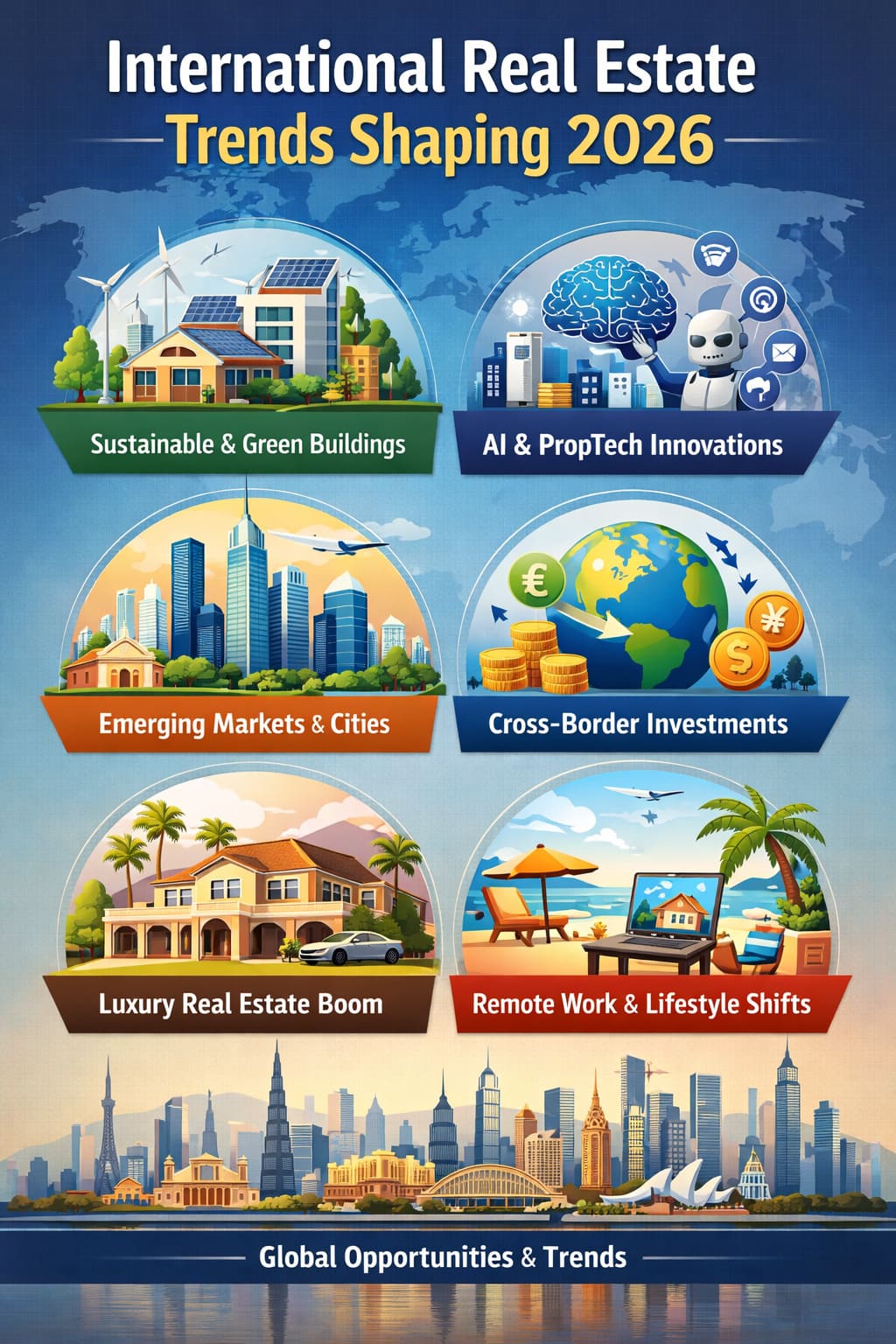
International Real Estate Trends Shaping 2026
CategoriesReal Estate

International Real Estate Trends Shaping 2026

The international real estate market is entering 2026 with renewed momentum, driven by shifting economic conditions, evolving investor priorities, and increased cross-border activity. After a period of volatility influenced by inflation, interest rate adjustments, and geopolitical uncertainty, global property markets are showing signs of stabilization.

Investors are adapting to a new environment where strategic positioning, asset quality, and long-term resilience matter more than short-term speculation.

One of the most notable trends is the steady recovery of prime residential markets in major global cities. Locations such as Dubai, London, Singapore, and Miami continue to attract high-net-worth individuals seeking capital preservation, lifestyle advantages, and tax-efficient jurisdictions. Dubai, in particular, remains a standout performer, with sustained demand from international buyers and investors benefiting from regulatory transparency and investor-friendly policies.

Commercial real estate is also evolving. While traditional office spaces faced challenges during the post-pandemic years, prime-grade assets in central business districts are regaining interest, particularly those offering modern infrastructure, sustainability certifications, and flexible layouts.

Investors are now prioritizing ESG-compliant buildings and energy-efficient developments, recognizing that sustainability has become both a regulatory requirement and a competitive advantage.

Meanwhile, logistics and industrial assets remain strong performers globally. The continued growth of e-commerce, supply chain diversification, and regional manufacturing strategies have increased demand for warehouses, fulfillment centers, and last-mile distribution hubs. Institutional investors are actively reallocating capital toward these asset classes, viewing them as more resilient in fluctuating economic cycles.

Emerging markets are also gaining attention. Countries in Southeast Asia, parts of Eastern Europe, and selected African regions are witnessing infrastructure investments and urbanization projects that create new real estate opportunities.

Strategic investors are entering these markets cautiously, focusing on partnerships, due diligence, and long-term growth potential. Interest rate policies remain a key factor influencing global property transactions.

While central banks have begun easing monetary tightening in certain regions, financing conditions still require careful structuring. Developers and investors are increasingly relying on joint ventures, private equity, and structured financing solutions to maintain project viability.

Another important shift is the rise of digital transformation in real estate. PropTech solutions, virtual viewings, blockchain-based transactions, and AI-driven valuation tools are streamlining operations and enhancing transparency. International investors now expect data-driven insights, real-time reporting, and efficient transaction processes as standard practice.

Despite ongoing global uncertainties, real estate continues to be viewed as a strategic asset class for diversification and long-term value creation. Demand for secure, income-generating properties remains strong, particularly in politically stable jurisdictions with clear regulatory frameworks.

As 2026 progresses, the international real estate landscape will likely be defined by adaptability, sustainability, and cross-border capital flows. Investors who combine market intelligence with disciplined risk management will be best positioned to capitalize on emerging opportunities while navigating an increasingly interconnected global market.